 Digital Transactions Authoritative, insightful and timely information for payments professionals

As the number of U.S. consumers who have heard nothing at all about artificial intelligence continues to drop, organizations are preparing for the expected infusion of AI into everyday life. Payments companies are no exception. American Express Co. is releasing a software-development kit called Agentic Commerce Experiences to help consumers and merchants navigate the burgeoning agentic-commerce arena.
Dubbed ACE, the service provides the technical specifications developers need to enable American Express-issued cards into AI-enabled interactions with a trust and control emphasis. Among its central elements is a registration service for AI agents to verify that only trusted agents are authorized to conduct transactions on the AmEx network. Initially, only U.S.-issued AmEx cards proprietary to AmEx, will be eligible for integrations made with the ACE kit.


The kit also makes it easy for cardholders to register their cards for agentic transactions and to ensure each cardholder purchase intent is accurately captured. Other elements include the ability of authorized agents to complete payments for AmEx members using tokenized credentials and a utility called Cart Context. This supports sharing cart details before or after a transaction to improve validation, authorizations, and dispute investigations, AmEx says.

“We believe agentic commerce is a massive sea change,” Luke Gebb, AmEx executive vice president and global head of innovation, tells Digital Transactions News, equating it to the introduction of Web-based commerce and mobile commerce for its potential to alter consumer commerce.
Preparing the payments ecosystem for its agentic commerce role is critical. Not only are more consumers aware of AI (Pew Center data says only 5% of consumers know nothing at all about AI), merchants want to ensure consumers can pay in any option they choose.
At the heart of all this is trust.
Trust and control is central to ACE kit and how AmEx will approach agentic commerce in general, Gebb says. “The industry has been grappling with the notion of acquisitions on behalf of humans,” he says. “Trust and security is at the center of it all.”
That’s why, in addition to the tool for software developers, AmEx also launched the Agent Purchase Protection program, which will help AmEx cardholders resolve possible registered agent purchase errors.
Because AmEx is the issuer, network and acquirer, these services can be tightly integrated, Gebb says. That should produce a competitive advantage for the card brand, such as making it easier to manage challenges agentic commerce might present.
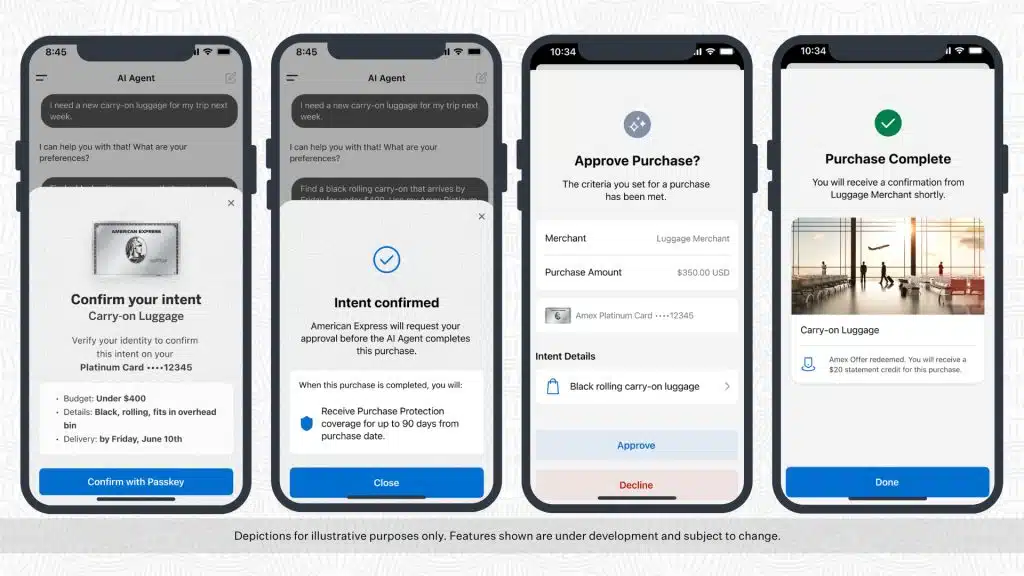
Gebb says the two services will work together to give its estimated 34 million U.S. cardholders (according to an Amex digital ads Web page) confidence and clarity so they can step into agentic commerce. The services also could reduce chargebacks and other problems, too, he says.
The payoff for AmEx cardholders is that confidence. “We want consumers to feel confident that they can transact this way and we have their back,” Gebb says.
The ACE Developer Kit is one part of the AmEx agentic-commerce approach. Two other components are ensuring its products, such as Resy restaurant booking and, eventually, Amex Offers and American Express Travel, are discoverable and actionable in AI platforms, and creating proprietary AI-enabled services across its owned platforms to help its card members in their relationships with the card company.
Amex isn’t alone in the program. Initial supporting payments partners include Adyen, Fiserv, Forter, Global Payments, PayPal, and Stripe. Merchant partners include Delta, Expedia, and Hilton.