 Digital Transactions Authoritative, insightful and timely information for payments professionals

A little more than two years since introducing its Kiosk product for restaurants, Square has revised the device by making it larger and adding artificial intelligence features to its ordering system.
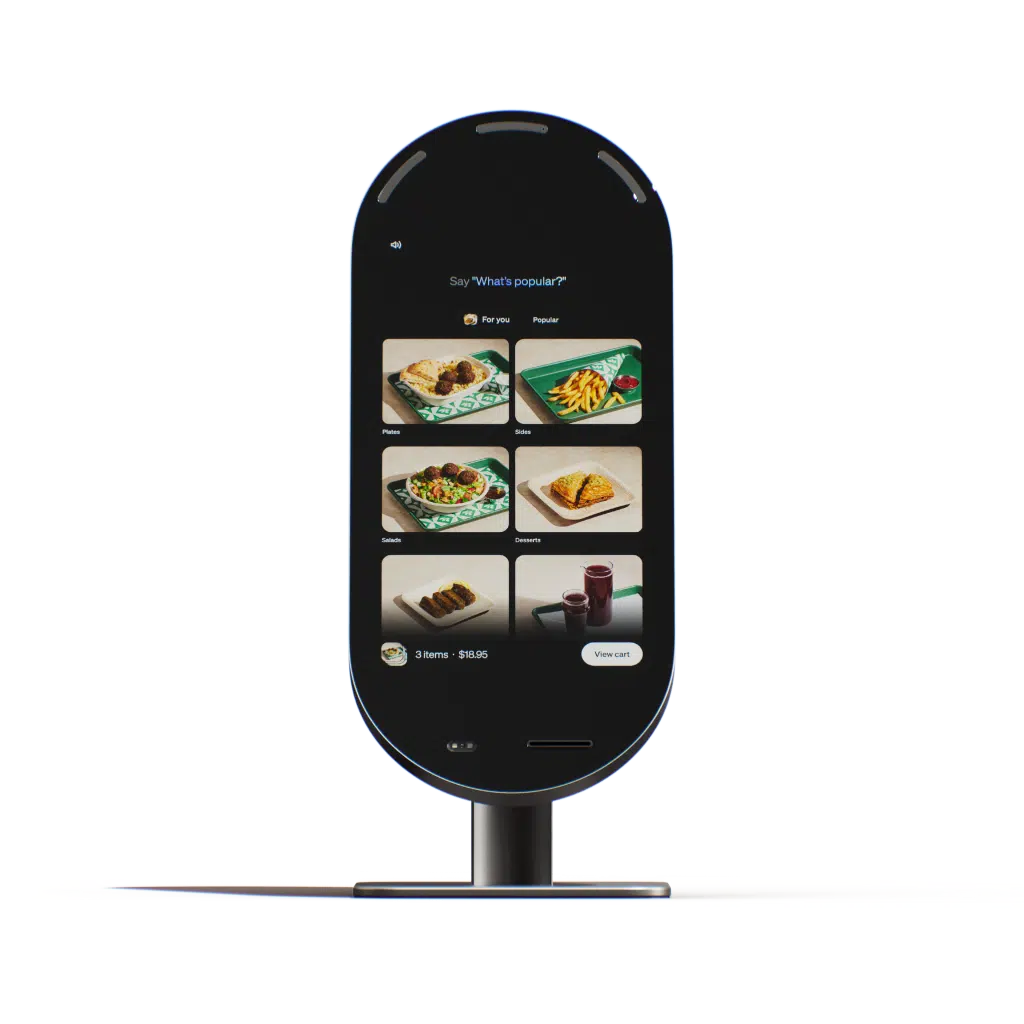
Announced Wednesday, the updated Kiosk moves away from a tablet-like appearance, which relied on the restaurant operator providing an iPad as the touchscreen display, to a much larger, vertically-aligned unit with its own 21.5-inch display. Its price starts at $1,999 with a countertop stand, and it requires a $99 monthly software subscription fee per device. Square continues to offer an iPad-compatible device called Square Stand, priced at $149. A standard iPad has an 11-inch screen.


Kiosks are a valuable point-of-sale form factor. One forecast says the U.S. interactive kiosk market will grow to $9.53 billion by 2030, up from $6.79 billion in 2025, according to a MarketsandMarkets report.
Square also announced new multi-account services for quick-service restaurant franchises, providing them with a suite of tools to more easily manage menus, reporting, and gift cards, while ensuring franchisees retain autonomy and flexibility to manage their locations.
The new Kiosk also includes voice-ordering capabilities that are aided with an agentic, conversational voice layer that Square says can understand the restaurant’s menu and respond in real time. The expectation is the new format and AI assistance will translate into faster moving lines, upsell opportunities, and reduced strain on customer-facing employees, Square says.
Kiosk also can provide a personalized check-in for consumers when they connect their Neighborhoods profile or Square Loyalty account. Neighborhoods, launched a year ago, connects sellers with Cash App users. Kiosk also has the usual complement of card-interface methods for tapping and dipping.
The AI component, combined with the voice interface, can help suggest items and add-ons, Square says, based on real-time contextual information, such as what’s popular at a location, the time of day, and common items to pair. Diners also can ask about allergy information and vegetarian options, and Kiosk can highlight upsells within the order process.
As kiosk use has proliferated, merchants and consumers have to come expect better self-service experiences.
“In general, many kiosks function more like digital menu boards than real ordering assistants. Buyers can add items and complete a transaction, but browsing the menu can feel like a maze, and staff often need to step in to answer questions or troubleshoot orders,” a Square spokesperson tells Digital Transactions News.
Kiosk makes self-service feel less like navigating a menu and more like getting help with someone who knows the business, the spokesperson says.
“Its agentic AI is grounded in the seller’s menu and sales data, so it can answer questions, suggest items, handle modifications, and surface relevant upsells. Guests can use voice, touch, or a combination of both, depending on what feels most natural. That matters during a rush, when staff are often juggling several tasks at once,” the spokesperson says.
For those using the voice interface, the Kiosk uses three directional microphones in conjunction with hardware- and software-based noise filtering to ensure only the active conversation is picked up. Kiosk only listens during an active order session, the spokesperson says. Kiosk is the first voice ordering-enabled POS device for Square.
“When Square Kiosk is on its idle screen, voice is disabled, and it is not listening. The device has no camera – presence detection is handled through sensors,” the spokesperson says. Enabling the voice interface is an option for both the consumer and the restaurant operator.
Square, a unit of Block Inc., also says sellers can add their logos to Kiosk’s idle screen. This is in addition to the menu customization, which sellers build and manage in their Square Dashboard portals.
“To make a menu available on Square Kiosk, sellers simply turn on Kiosk as one of the places that a particular menu appears, alongside other sales channels. The more detail a seller adds, like item descriptions and allergen information, the more helpful Square Kiosk’s AI capabilities become—while imagery they add to items helps bring the menu to life visually,” Square says.
Sellers can also specify when different menus should appear in Kiosk, based on time of day with no manual switching.