 Digital Transactions Authoritative, insightful and timely information for payments professionals


“White-label” has become a popular term in the payments ecosystem, alongside ISO, PayFac, and PayFac-as-a-Service. There are many ways to bring a branded payments experience to the market. Some providers own the underwriting, risk, and operational infrastructure behind that experience. Others rely on a third party to provide these functions.
While the difference may not be visible to ISOs and merchants, it can significantly impact onboarding speed, risk, approval flexibility, and the ability to support a wider range of merchant verticals. It can also influence how consistently a provider delivers the merchant experience across banks, processors, and programs.
For ISOs evaluating a processing partner, the more useful question isn’t whether they can white-label, but who really owns the risk, who makes the decisions, and who ultimately owns the experience.
What “Full-Service Payment Provider” Actually Means
A true Full-Service Payment Provider (FSP) doesn’t just distribute payment processing. They operate the infrastructure behind it. That includes managing underwriting, risk management, compliance oversight, and relationships with the sponsor banks and card networks that enable merchant processing across risk types.
That’s a big distinction from an ISO or ISV that white-labels while routing the underlying processing, risk decisions, and settlement through a third-party processor and bank.
Multiple models exist for good reasons. Not everyone wants to own underwriting and risk in-house. But outsourcing those functions comes with a different level of control, accountability, and flexibility than owning them, and partners should understand the distinction.
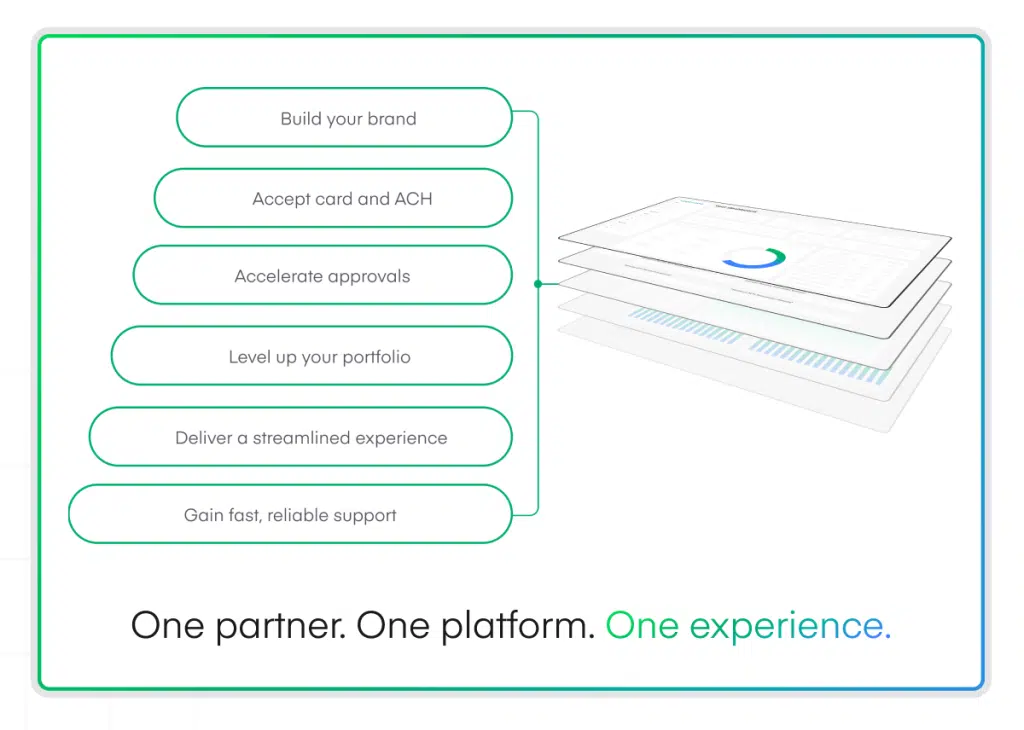
Retail, Wholesale, and the Ownership Gap
A retail ISO typically works directly with a processor, operating within their underwriting guidelines, risk, and compliance framework. Whereas a strong FSP can let a partner’s brand lead while still owning the risk and infrastructure behind it.
A wholesale ISO takes on more independence by sharing in liability or operations but still depends on an underlying processor for the risk and processing infrastructure it does not own. With the growth of ISVs and vSaaS, more PayFac-as-a-Service platforms have emerged, but many operate under similar constraints that ultimately hinder ISVs at some point in their embedded payments journey.
If you are evaluating providers, that’s an important distinction. The branding may be yours, but the operational decisions that shape the merchant’s experience may not be.
Why it Matters
When risk and underwriting sit with a third party, decisions about approvals, reserves, account holds, and exceptions move through an extra layer and set of priorities that may not match your own.
Policy changes at the underlying processor can ripple down to every reseller and merchant relying on it, often without much warning. And when something goes wrong, it can be unclear who is actually accountable for fixing it.
An organization that holds its own FSP status controls that chain end-to-end, including underwriting speed, risk tolerance, funding, compliance, and operational support, rather than inheriting someone else’s decisions and timeline.
The benefits go beyond control.
Greater ownership can lead to faster onboarding, more direct communication, clearer accountability, and a better partner experience with more modern technology choices. When underwriting, risk, and support teams work in-house within the same organization, questions can be answered faster, and decisions can be made with greater context.
As payments become an increasingly strategic revenue driver, those advantages can have a meaningful impact on growth, merchant satisfaction, and long-term scalability.
The Question Worth Asking
Before signing up with any processing partner that markets white-label capabilities, it’s worth asking directly: Who underwrites this account? Who holds the risk? Who makes the decisions? And who is accountable if a problem arises?
The answers reveal whether you’re partnering with an FSP or with a brand built on top of one.
In an industry where most platforms can be branded, the real differentiator isn’t the logo on the portal. It’s who owns the decisions and infrastructure behind it.
Before choosing a payments partner, ask not just who powers the platform, but who owns the outcome. The answer may have a greater impact on your business than any feature list ever will.
Ready to look beyond the label? Contact Maverick to learn how a true Full-Service Payment Provider can help you scale with greater speed, flexibility, and control.

Established in 2012, Maverick Payments is a leading, privately owned, full-service payments provider. Built to empower ISOs and ISVs to easily monetize payments, Maverick provides a unified payments infrastructure spanning multiple processors and banks via an inclusive dashboard and API. The full merchant lifecycle is managed in-house, enabling Maverick’s partners to support all risk profiles and grow with one partner, one platform and one experience. To learn more, visit: maverickpayments.com