 Digital Transactions Authoritative, insightful and timely information for payments professionals

Shopify Inc.’s latest update to its point-of-sale and e-commerce platform makes artificial intelligence commerce uses central, enabling its merchants to more easily adopt agentic commerce as a channel.
The Spring platform update, which includes more than 150 revisions, adds support for sign in with Shop, its consumer-facing app and marketplace, via the new Catalog API to Shopify Catalog, helping them see personalized results. Shopify Catalog is the global database of eligible products sold by stores on Shopify. Developers also will be able to use the new Catalog API to build services like image search and add more product attributes.


Shopify also made it easier for developers to adopt the Universal Commerce Protocol, an agentic commerce technology co-developed with Google, and Catalog to create new shopping experiences. The Ottawa, Ontario-based company also made it easier for merchants to manage their AI channels in a single place in the admin panel of the app.
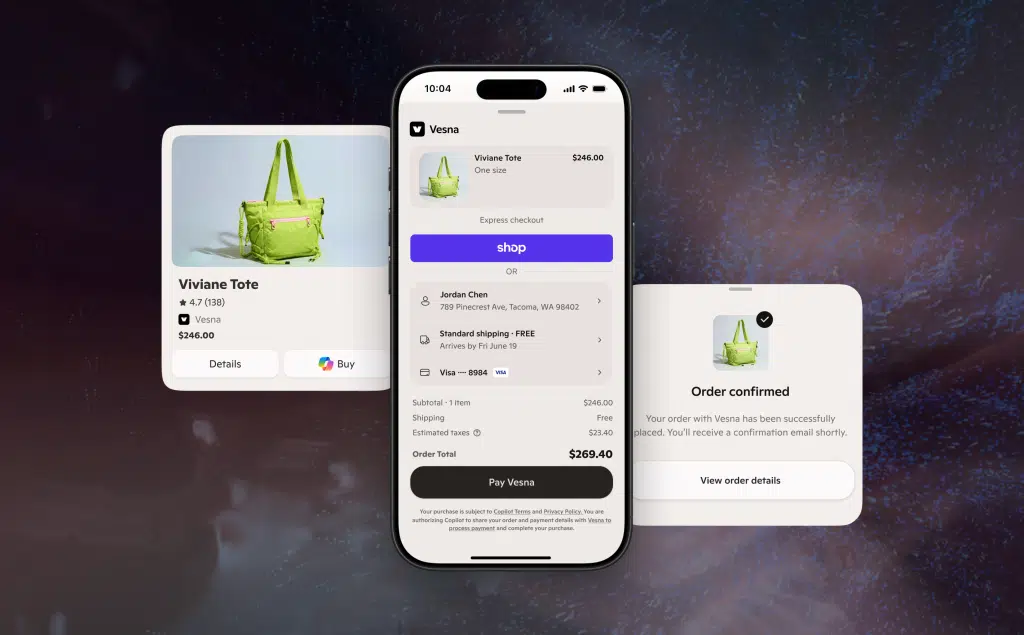
Other elements include extending Shop Pay, its digital wallet, to sites not on the Shopify platform, making enterprise-level tools available to all merchants, and simplifying global selling. Shop Pay processed $35 billion in gross merchandise volume in the first quarter, up 59% year-over-year.
“We are enabling our merchants to sell everywhere,” Rohit Mishra, Shopify vice president of product, tells Digital Transactions News. That used to mean as an omnichannel seller, he says. “In this day and age, it’s about how our merchants can expand their businesses and sell on every surface.” In 2021, it extended Shop Pay to non-Shopify merchants selling on Facebook, Instagram, and Google.
The Catalog API and UCP capabilities will help Shopify merchants ready for the expected upsurge in agentic commerce, Mishra says. Merchants can click a button and make their whole catalog available, he says.
In addition to meeting consumers in emerging AI sales channels, Shopify also wants to make it easier for them to use its services in more established ones. That’s part of the rationale for making Shop Pay, its digital wallet and assistant, more easily available to merchants of all sizes not on the Shopify platform.

“Shop Pay has been our bread and butter of how we delivered great conversion [rates] for merchants on our platform,” Mishra says, adding that its use continues to grow. Expanding its availability to non-Shopify merchants is especially helpful to enterprise-level ones who may not be able to easily shift their e-commerce operations.
Prior to this update, merchants not on the Shopify platform could add Shop Pay to their checkout flows, but that required contacting the platform’s sales department and following a more complex integration path. “There was a lot more work involved in getting started,” Mishra says. “Now, this works just like anything you expect on Shopify.”
On the global front, Shopify will use its data network to automatically bring local payment methods to the attention of merchants that sell internationally. “Merchants are not experts on what [payment] methods they should be offering,” Mishra says. Because of the scale of Shopify’s data—it says “millions” of merchants in 175 countries use its services—it can enable merchants to create localized storefronts, he says, something it has done for a while.
Working with Global-e, a cross-border payments specialist, it can offer adaptive international pricing that includes currency-conversion fees. Now, Shopify can provide pricing that includes all fees, taxes, and tariffs and help these merchants generate the same revenue as they would on a domestic order. Instead of an international shopper seeing multiple fees, they see one price. Mishra says Shopify is using its data in this context to help determine the selling price and how it should be presented in each market.