 Digital Transactions Authoritative, insightful and timely information for payments professionals

As agentic commerce develops, payments and technology companies are teaming up to ensure this next permutation of e-commerce is available to merchants and consumers. PayPal Holdings Inc. and Google Cloud are the latest examples with the announcement of a service that combines Google Cloud’s Conversational Commerce agent with PayPal’s payments expertise.
This means merchants using the new artificial intelligence-powered tool will be able to deploy it directly on their digital channels while retaining control over the tone and look of the agent and the customer relationship.


Agentic commerce enables AI agents to engage with online shoppers throughout their shopping and buying, including the product-discovery phase, to purchase and post-purchase support. AI agents, which leverage artificial intelligence to complete tasks on behalf of a shopper, have the ability to understand individual customer needs and preferences and offer personalized recommendations.
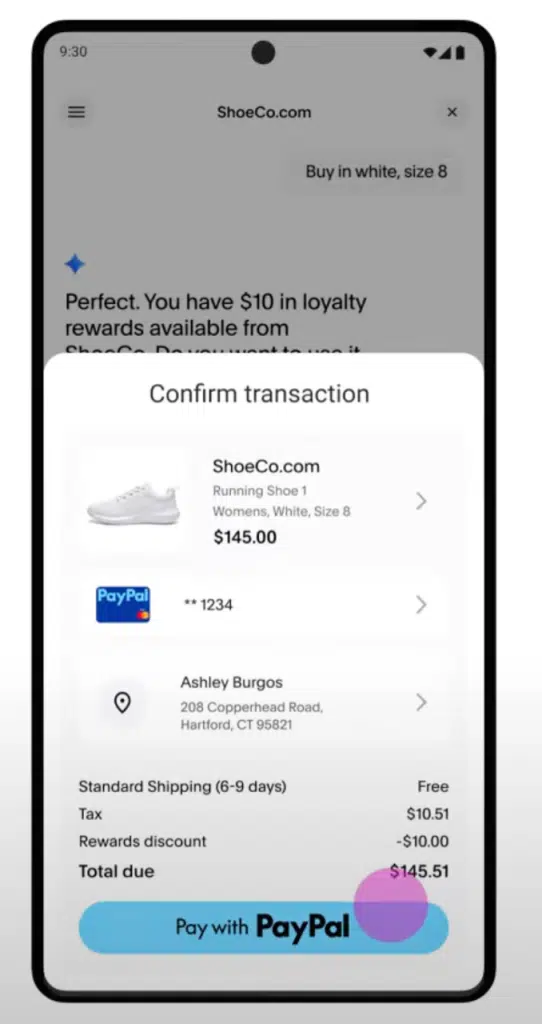
It will work with the PayPal Agent communicating securely with the merchant’s agent using the Agent2Agent Protocol, an open standard meant to ease communication and collaboration between AI agents, and will be integrated with the Agent Payments Protocol, Google’s service to authenticate consumers initiating a payment using an AI agent when shopping online. Google launched its AI-assisted shopping service in September.
The two protocols work in conjunction to enable AI agents to communicate with one another and to secure agentic transactions.
Google says merchants will be able to adopt Google Cloud’s Conversational Commerce Agent, which uses human-like conversations to guide consumers through an agentic commerce transaction, to act as their agent. Or they can use the Google Agent Development Kit to build their own.
That agent will then communicate with the PayPal agent during product discovery and selection to learn more about the user’s shopping history, which is based on data the consumer gave permission to use, to improve product recommendations. Then, when the consumer is ready to check out, the PayPal agent will provide the checkout experience. This agent also can offer payment-method recommendations and see if the transaction is eligible for a buy now, pay later option.
The combined Google Cloud and PayPal agentic-commerce service also uses technology called mandates to help ensure the veracity of the user’s intent. One example is a cart mandate. This is the credential that is used when the user is present to authorize a transaction. They are generated by the merchant and cryptographically signed by the user, typically by their device.
The other element is a payment mandate, which is shared with the payment network and issuer to provide details about the nature of the agentic transaction.
These are foundational elements of the guardrails and parameters put into place in the new service, says Toby Brown, Google’s global head of regulated industries. “Those mandates are really what establishes our sense of security,” Brown says. Merchants can configure the security controls based on their own appetite for risk. The mandates are innovations that are central to the service, Brown says.
This latest development follows a move by Google and PayPal in September to work together on agentic commerce.